

Seeds at the Magic Pond
A Puzzle that opens up when you walk it backwards



A pond with a secret
Beside a small lake there is a bird sanctuary. Feeding stations stand along the bank. Every morning a volunteer walks along the path with a cloth bag of seed packets and fills the stations, so that the birds have food for the day.
The lake is not an ordinary lake. Dip the bag in the water and every packet inside becomes two packets. The volunteer dips the bag once at each station, as she arrives.
The volunteer keeps three rules of her own.
- She brings all her packets at the start of her walk. She cannot go back for more.
- She leaves the same number of packets at every station.
- She walks home with an empty bag.
There are no half packets; all packets are identical and each packet is considered a whole.
So, her stop at each station of a walk looks like this. Arrive. Dip the bag. Leave the agreed number. Walk on. Here is the question. How many packets should she bring initially, and how many should she leave at each station?
Well, that depends on the number of stations, doesn’t it? Let us deal with this problem with the smallest number of stations. This puzzle is much better if you meet it in stages.
One station
Start with a sanctuary that has only one station. She arrives, dips the bag, and leaves everything, because the bag has to be empty when she goes home.
Bring 1 packet. It becomes 2. She leaves 2. Bring 5 packets. They become 10. She leaves 10.

When there is only one station, every number works, and the smallest solution is 1 packet in, 2 packets left. Notice something already. She leaves more than she brought. The pond is supporting her giving.
Two stations: Guess and check
Now put two stations on the path. This is harder, because whatever she leaves at the first station she must also leave at the second.
Try guessing. Table 1 shows four guesses, the reader may try more.
| Volunteer | At Station 1 | At Station 2 | What happened |
|---|---|---|---|
| Brings 2, leaves 3 | dip: 4, leave 3, bag 1 | dip: 2, cannot leave 3 | She runs out of packets. |
| Brings 2, leaves 4 | dip: 4, leave 4, bag 0 | nothing left to dip | She runs out of packets. |
| Brings 3, leaves 4 | dip: 6, leave 4, bag 2 | dip: 4, leave 4, bag 0 | Exactly right |
| Brings 4, leaves 4 | dip: 8, leave 4, bag 4 | dip: 8, leave 4, bag 4 | 4 packets left over |
Two kinds of failure appear here, and both are worth noticing. Sometimes she runs out before the last station. Sometimes she still has packets in the bag at the exit gate. We notice that the cases for leaving 3 or 4 packets were tried, and not all the cases gave working solutions.
When there are two stations, the number of solutions decreases.
There are two dips of the bag, and the number of seed packets doubles twice.

A correct answer emerged at the end. What if it was related to the number of packets brought in, and the fact that the number of seed packets doubled twice?

What-if questions help us understand the problem and arrive at possible solutions.
Three stations: Turn the walk around
Add a third station and suddenly, there are too many choices. There are two numbers to choose, the number she brings, and the number she leaves, and most pairs fail. A technique that mathematicians use sometimes is to work backwards from the desired end. So, stop making the guesses about the number of packets she brings in at the start of the walk and look at the end of it instead. At the end we know something precisely. The bag is empty.
Work backwards from there. Now the number of packets have doubled thrice. What if she leaves 2 × 2 × 2 = 8 packets at each station?
At Station 3 (the last one)
- She leaves 8 packets and goes home with 0.
- So after the dip she had 8 packets.
- Before the dip (when she arrived), she had half of 8 = 4 packets.
She arrived at Station 3 with 4 packets.
At Station 2
- She leaves 8 packets, and leaves the station with 4 packets (the 4 she carried to Station 3).
- So after the dip she had 4 + 8 = 12 packets.
- Before the dip she had half of 12 = 6 packets.
She arrived at Station 2 with 6 packets.
At Station 1 (the first one)
- She leaves 8 packets, and leaves the station with 6 packets (the 6 she carried to Station 2).
- So after the dip she had 6 + 8 = 14 packets.
Before the dip she had half of 14 = 7 packets.
She started with 7 packets!
Every step from the last station to the first, is the same pair of moves. Add 8 to the number she departed from the station with, then halve, because halving does the reverse of what the dip does.
Now walk it forwards to check.
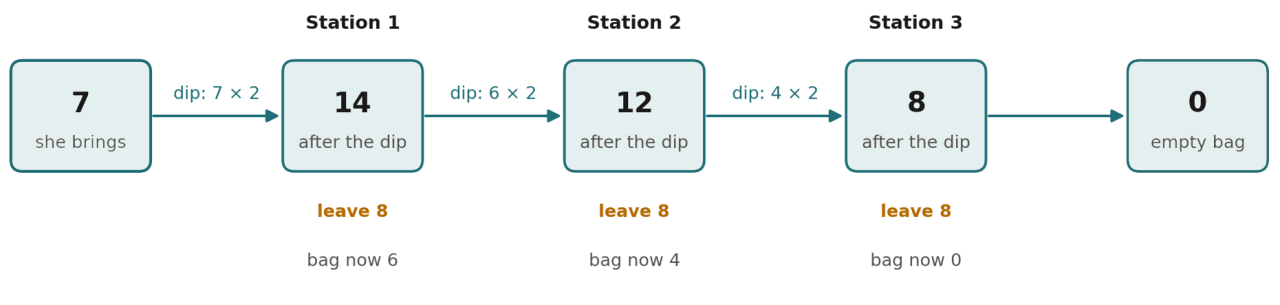
Why leave 8 packets and not 2, 4, or 6?
Let’s try with 4 packets
At Station 3 (the last one)
- She leaves 4 packets and goes home with 0.
- So after the dip she had 4 packets.
- Before the dip (when she arrived), she had half of 4 = 2 packets.
She arrived at Station 3 with 2 packets.
At Station 2
- She leaves 4 packets, and leaves the station with 2 packets (the 2 she carried to Station 3).
- So after the dip she had 2 + 4 = 6 packets.
- Before the dip she had half of 6 = 3 packets.
She arrived at Station 2 with 3 packets.
At Station 1 (the first one)
- She leaves 4 packets, and leaves the station with 3 packets (the 3 she carried to Station 2).
- So after the dip she had 3 + 4 = 7 packets.
- Before the dip she had half of 7 = 3.5 packets.
That is not possible! She cannot start with 3.5 packets.
(Similarly, we can argue that 2 or 6 packets will not work.
Question: Why can’t we leave an odd number of packets at each station?)
Line up the answers
Let’s look at the patterns in the solutions for 1, 2, and 3 stations.
| Number of stations | 1 | 2 | 3 | |||
|---|---|---|---|---|---|---|
| What happens in the bag? | First station | Last station | First station | Second station | Last station | |
| Packets on arrival at station | 1 | 3 | 2 | 7 | 6 | 4 |
| Packets after the dip | 2 | 6 | 4 | 14 | 12 | 8 |
| Packets left for the birds at the station | 2 | 4 | 4 | 8 | 8 | 8 |
| Packets carried onwards | 0 | 2 | 0 | 6 | 4 | 0 |
Teacher’s Note
Give students time to study the table and describe the patterns in their own words. They may notice patterns other than those listed below.

- In the one-station walk, the volunteer leaves 2 packets. In the two-station walk, the volunteer leaves 4 packets at each station. In the three-station walk, the volunteer leaves 8 packets at each station. As the number of stations increases, these numbers follow the pattern 2, 4, 8: each number is double the previous number.
- The volunteer starts with 1 packet for one station, 3 packets for two stations, and 7 packets for three stations. To get the next starting number, double the previous number and add 1.
- In the three-station walk, the number of packets in the bag falls from 7 to 6, then from 6 to 4, and finally from 4 to 0. The decreases are 1, 2, and 4. Each decrease is double the Once students recognise the pattern, they could be asked to predict the numbers for 4 stations
- and then verify their prediction by doing the walk.previous one.
Once students recognise the pattern, they could be asked to predict the numbers for 4 stations and then verify their prediction by doing the walk.
Let us analyse the leave numbers by walking backwards:
- Across one station means halving once. So. the number she leaves should be a multiple of 2. The smallest multiple of 2 is 2 and if she leaves 2, then she should have come in with 1.
- Across two stations, means halving twice. So, the number she leaves should be a multiple of 4.
- Across three stations means halving three times. Only a multiple of 2 × 2 × 2 (which is 8), can be halved three times and still result in a whole number. So, the number she leaves should be a multiple of 8.

One halving for every station. That sentence is one part of the mathematics of this puzzle.
What about the number of seed packets she brings to the first station of each circuit? We noticed that these (1, 3, 7) are twice the previous number plus 1 across the row. Does this relationship work if she brings (2, 6, 14) packets to the 1-station, 2-station and 3-station circuits?
Note: If she correspondingly leaves 4, 8, and 16 packets at each of these circuits, these are valid solutions. You can test and see for yourself. But the pattern followed by (1, 3, 7) is not followed by (2, 6, 14).
Patterns may break unexpectedly, they need to be tested and proved before generalizing!

Watch the bag empty
There is one more pattern, and it turns out to be the important one.
Follow the bag along the three -station circuit.
| Station number | 1 | 2 | 3 |
|---|---|---|---|
| She brings to the station | 7 | 6 | 4 |
| She departs from the station with | 7 × 2 – 8 = 6 | 6 × 2 – 8 = 4 | 4 × 2 – 8 = 0 |
| Decrease = Difference between what she brought and what she departed with | 7 – 6 = 1 | 6 – 4 = 2 | 4 – 0 = 4 |
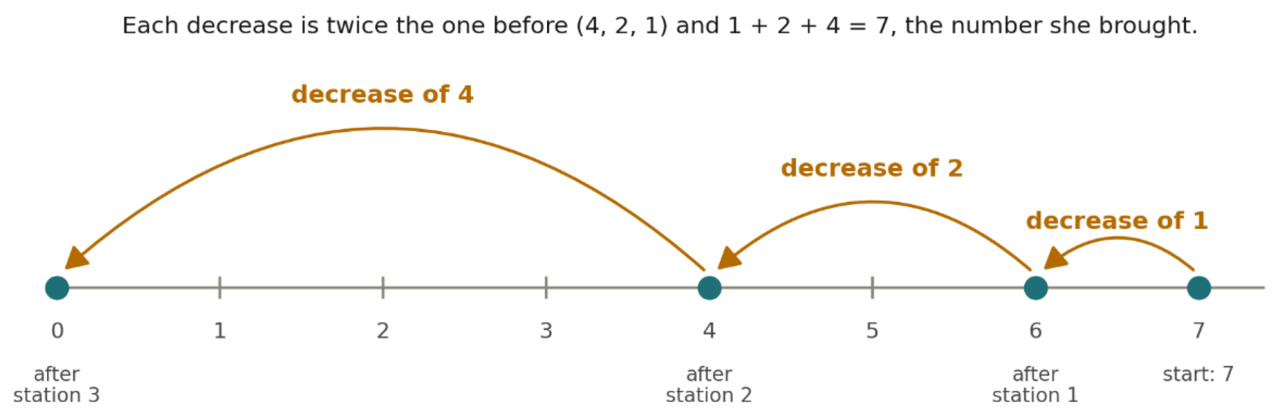
The decreases (7-6, 6-4, 4-0) are 1, 2, and 4. Each decrease is double the one before, and the decreases add up to 7, the number she brought. That is not a coincidence. The last decrease has to empty the bag, the decrease before it is half as big, and so on all the way back to the start.
Similarly for a 2-station circuit, the decreases (3-2, 2-0) are 1, 2. Each decrease is double the one
before, and the decreases add up to 3, the number she brought.
So, in summary,
| Number of Stations | The decreases | The smallest number she can bring to Station 1 |
|---|---|---|
| 3 | 1, 2, 4 | 7 i.e., (1 + 2 + 4) |
| 2 | 1, 2 | 3 i.e., (1 + 2) |
| 1 | 1 | 1 |
For the bag to empty, the sum of the decreases has to add up to the original number brought to the pond.

Check if the patterns you have noticed so far work for more stations. After you try, you can verify some of the numbers from Table 5.
What is the pattern you observe between the leave and the bring number (difference between the green and blue rows)?
| Stations | 1 | 2 | 3 | 4 | 5 | 6 |
|---|---|---|---|---|---|---|
| She brings | 1 | 3 | 7 | 15 | 31 | 63 |
| She leaves | 2 | 4 | 8 | 16 | 32 | 64 |
Now ask for a prediction for seven stations and let a student test it by walking the whole journey.

Observing patterns can help us find many connections and many ways to explore a problem.
A pond that multiplies by ten
What if one dip in the pond turns every packet into ten packets? Ask for a prediction before anybody calculates, using the two rules the class has just built.
- The leave number should be multiples of 10, once for each station.
- The bring number should be the sum of the decreases, and the decreases now multiply by ten: 1, then 10, then 100.
| Number of stations | 1 | 2 | 3 | |||
|---|---|---|---|---|---|---|
| 1st station | 2nd station | 1st station | 2nd station | 3rd station | ||
| Packets on arrival at station | 1 | 11 | 10 | 111 | 110 | 100 |
| Packets after the dip | 10 | 110 | 100 | 1110 | 1100 | 1000 |
| Packets left for the birds at the station | 10 | 100 | 100 | 1000 | 1000 | 1000 |
| Packets carried onwards | 0 | 10 | 0 | 110 | 100 | 0 |
The patterns that were predicted seem to be holding even when the pond multiplies by ten! (Students may recognise the role played by place value in these patterns.)
| Stations | 1 | 2 | 3 |
|---|---|---|---|
| She brings | 1 | 11 | 111 |
| She leaves | 10 | 100 | 1000 |
Now test the last pattern, the difference between the leave and bring numbers. The pattern we observed previously was that this difference was uniformly 1.
Here, the difference is 9, then 89, then 889, ……………
At this moment, we stop and realise that a pattern has to be tested. It cannot be taken for granted.
A bigger walk, for classes 7 and 8
What if the pond multiplies by 7? Let us predict with the two surviving rules before checking anything.
- The leave number should be multiples of 7, once for each station.
- The bring number should be the sum of the decreases, and the decreases now multiply by seven: 1, then 7, then 49.
Let us predict and then check for a circuit with four stations. The mathematics here focuses on pattern recognition, not on multiplication.
- Leave: 7 × 7 × 7 × 7, which is 2401.
- Bring: the drops 1, 7, 49 and 343, added up, which is 400.

Both rules hold for numbers far larger than anything the class has tried. The rule that died at the ten times pond stays dead: one less than 2401 is 2400, and she brought 400. So, the number of packets she brings is far smaller than the number of packets she leaves. (For the doubling pond, the bring number was one less than the leave number.)
One last thing to notice. She carries in 400 packets and leaves a total of 9604 packets, because 4 × 2401 = 9604. The pond is truly a multiplier of good intent!
| Number of stations | 1 | 2 | 3 | |||
|---|---|---|---|---|---|---|
| 1st station | 2nd station | 1st station | 2nd station | 3rd station | ||
| Packets on arrival at station | 1 | 8 | 7 | 57 | 56 | 49 |
| Decrease = Difference between what she brings to previous and next station | 1 – 0 = 1 | 49 – 0 = 49 7 – 0 = 7 |
399 – 343 = 56 56 – 49 = 7 |
|||
| Packets after the dip | 7 | 56 | 49 | 399 | 392 | 343 |
| Packets left for the birds at the station | 7 | 49 | 49 | 343 | 343 | 343 |
| Packets carried onwards | 0 | 7 | 0 | 56 | 49 | 0 |
In general, if there are n stations in the circuit,
She brings to the 1st station
1 + 7 + 72 + ……….7n-1 packets.
The pond multiplies by 7
7 + 72 + 73 + ……….7n packets.
She leaves 7n packets and departs with
7 + 72 + 73 + ……….7n-1
At the next station, the pond multiplies by 7
72 + 73 + 74 + ……….7n packets.
She leaves 7n packets and departs with
72 + 73 + 74……….7n-1
At each station, the last term gets dropped, the power of the first term increases by 1, the number of terms decreases. This continues till only one term is left and that is 7n which is deposited at the nth station.
Teacher’s Note:
- Be strict about the order at each station. Dip first, then leave. Somebody always reverses it in an early trial, and then no answer matches.
- Walk it before you write it. Counters or bottle caps for packets, four paper plates for stations, one child as the volunteer. Children who act it out stop mixing up the actions of dipping and leaving.
- Use the two kinds of failures. Ran out or had some leftovers; tell the class which way to move the next guess. That is estimation doing real work.
- Slow down at the reversal. Ask what we know for certain. The empty bag at the end is the only number in the whole puzzle we are sure of, and that is exactly why the end is a good place to start.
- Let the broken pattern stand. Students often accept a pattern after it has worked four times. The seven times pond is a memorable reminder that a pattern is a question until it is tested.
- For a confident group: which ponds give a bring number that is one less than the leave number? (Only the doubling pond does. Ask them to explain why, in words, using the drops.)
Questions to explore
- Doubling pond
- One station. She wants to leave 10 packets. How many does she bring?
- Two stations. She brings 6 packets. What must she leave, and does the walk work?
- Three stations. Find an answer that is not ‘Bring 7, leave 8’.
- Four stations. Predict first, then check by walking.
- Pond multiplies by five: Predict bring and leave numbers for two stations, then check.
- Pond multiplies by three:
- Predict bring and leave numbers for three stations, then check.
- Four stations: The decreases are 1, 3, 9 and 27. What does she bring, and what does she leave?
- The ten times pond: Five stations. Write down both bring and leave numbers without doing any long multiplication.
- A dull pond that does nothing at all to the packets. If there are three stations and she leaves 5 at each one, how many does she bring? What has been lost from the puzzle?
- Design your own pond. Choose the multiplying number and the number of stations, predict both answers, then test the walk. Hand it to a friend as a puzzle.
Answers
- Brings 5. 2) She must leave 8, and the walk works: 6, 12, leave 8, 4, 8, leave 8, 0. Leave 16 and bring 14, or leave 24 and bring 21. Any multiple of 8 (to leave) and the corresponding multiple of 7 (to bring) works. 4) Brings 15, leaves 16. (Or any multiple of these.)
- Brings 6, leaves 25.
- 1) Brings 13, leaves 27. 2) Brings 40, leaves 81.
- Brings 11111, leaves 100000.
- She brings 15, since nothing grows and she simply hands out 5 three times. The magic has gone, and with it the puzzle.
Where this puzzle comes from
This is an old puzzle in recreational mathematics. It is usually told with a pilgrim, a magic pond and a row of temples, and with flowers that double each time they are dipped. The best-known version has three temples, and the answer is to bring 7 flowers and offer 8 at each temple, which is exactly the three-station walk above. Versions with other multiplying numbers and more temples circulate widely in puzzle collections and on puzzle websites.
I met the puzzle as a school student in Bangladesh and worked out the general rule for myself in November 2007, before I had seen any published version. This article is offered in that spirit. It is a retelling and a classroom redesign, not a new result. The flowers have become seed packets for birds, an environment-friendly approach, which suits a pond somebody visits every morning.
Curricular connections
Suggested classes. Classes 4 and 5 to Table 3; classes 6 to 8 for the whole investigation.
Prerequisites. Doubling, halving, multiplication by a single digit, subtraction, recording in a table.
NCF-SE 2023. Middle Stage: Understands numbers and sets of numbers (whole numbers, fractions, integers, rational numbers, and real numbers), looks for patterns, and appreciates relationships between numbers.
NCERT. Ganita Prakash Class 6, Chapters 1 (Patterns in Mathematics) and 3 (Number Play); Class 7, Chapter 1.
In a Nutshell
What is the value of such an activity? We suggest the following, you may want to add more after trying it with your class.
- It is ideal for a mixed-ability class. There are different levels at which the problem may be attempted, and the initial levels are easily attainable by students with a basic understanding of doubling, halving, addition and subtraction.
- It models many problem- solving techniques: prediction, test and conjecture, pattern recognition, exploration, reasoning and the what-if technique.
- It gives the opportunity to build the skills of documentation, mathematical communication, and problem-posing.
- It illustrates the historical enjoyment of recreational mathematics.
- Saikia, M. (2012, July 12), The flower puzzle
- Akhila. (2015, September 6), Magical flowers!!
- Abhay. (2012, March 15), The three temples
- Temple, flowers and magic pond. (2011, March 16)
- National Council of Educational Research and Training. (2023). National curriculum framework for school education 2023: Mathematics
- National Council of Educational Research and Training. (2024–2025). Ganita Prakash (Classes 6 and 7: 1 and 2)
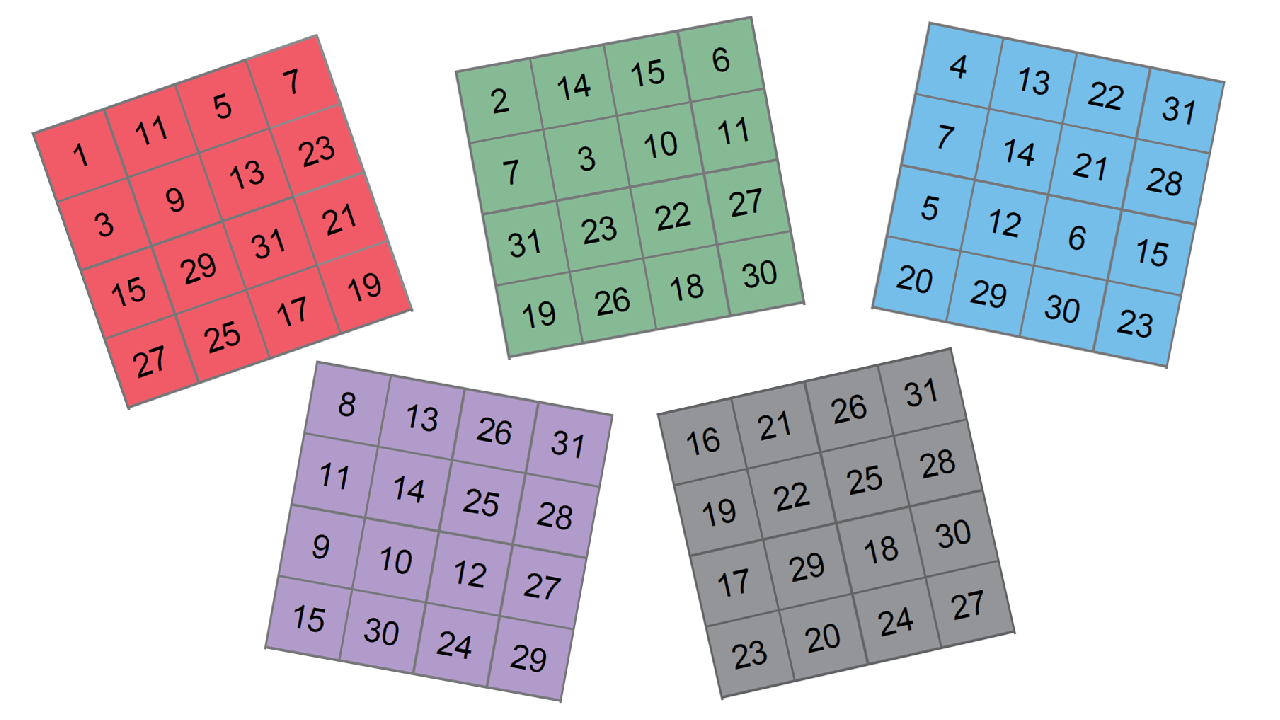
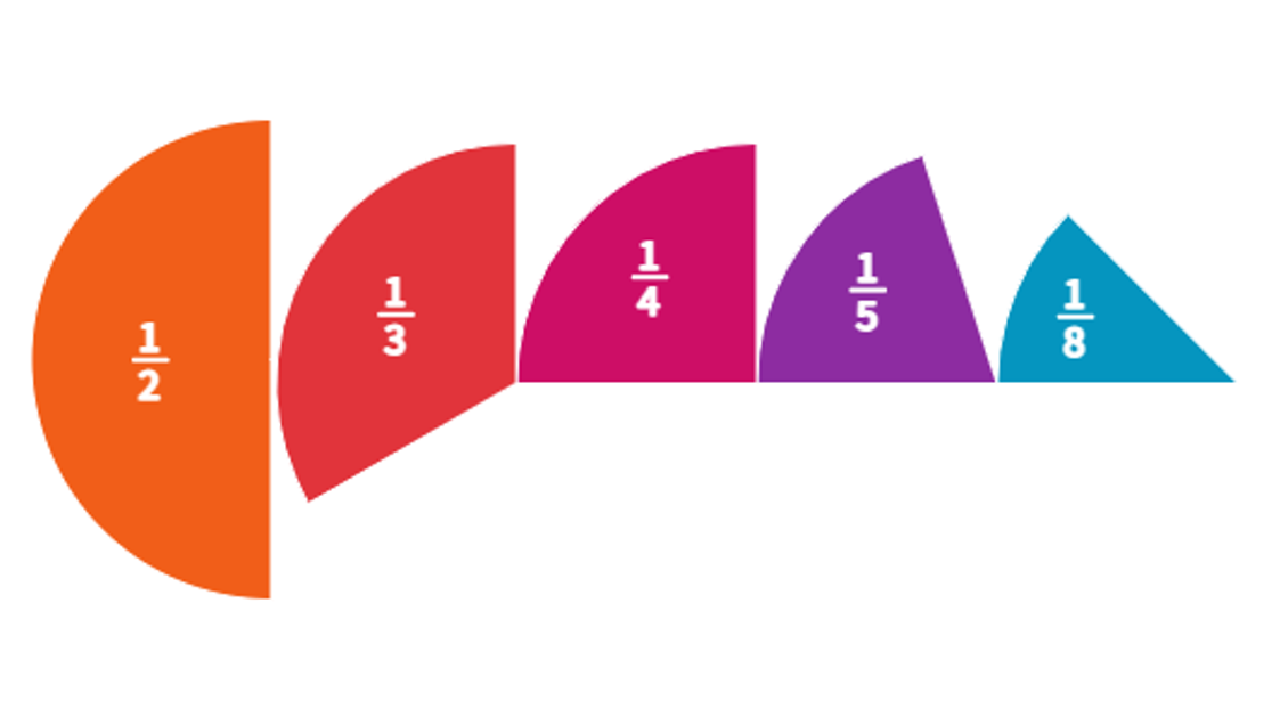
What are the patterns that you observe in: