

Is it Magic or Mathematics? Understanding the Number Table Trick


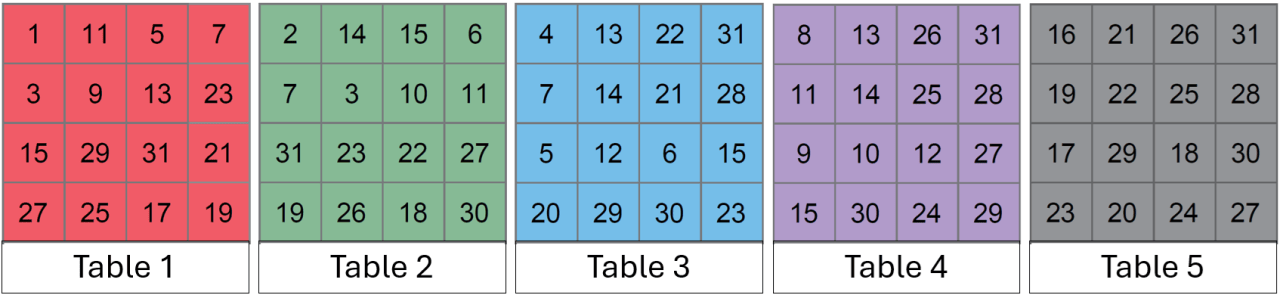
Mathematics often appears magical when it is used to design tricks. One such fascinating activity is this number table trick, where a person thinks of a number and the presenter quickly identifies it using a few tables. See Figure 1.
One version of the trick: Think of any date (1 to 31). Point to all the tables in which your date appears. And I’ll find your number.
The ‘magic’ behind this trick showcases how mathematics is connected with patterns, logic, and reasoning. It also shows that mathematics can be playful, engaging, and meaningful for learners. This article explores the mathematical idea behind the trick and explains how such number tables can be created using patterns.
First, let us check what the ‘magician’ does. Suppose the date chosen is the 19th. The person who chose this date reveals only that the number is in Tables 1, 2, and 5. The magician looks at the number in the top left corner of Table 1 (i.e., 1), Table 2 (i.e., 2), and Table 5 (i.e., 16). A quick mental addition 1 + 2 + 16 gives the number 19 which is the chosen date! That’s very impressive, but the patterns that are behind this trick are even more so!
This trick works because every number from 1 to 31 can be written as a sum of some (or all) of the numbers 1, 2, 4, 8, and 16 in a unique way. In fact, every positive integer can be uniquely written as the sum of the powers of 2. (By powers of 2, we mean those multiples of 2 in which 2 is only multiplied by itself. Note that 1, 2, 4, 8, and 16 are the first five powers of 2.)
For example, if we take 19, we divide by 16 which is the highest power of 2 that is less than 19. We get 19 = 16 × 1 + 3. Repeat the procedure by dividing the remainder by 2, 19 = (1 × 16) + (1 × 2) + 1= 16 + 2 + 1 = 19 which is exactly how we got the magical date.
Now the trick reduces to where we place the numbers! Obviously, the process of repeated division will tell us which tables should be used for which number. Try and complete Chart 1 on your own before looking at the products and sums in it.
| 1 | 2 | 3 | 4 | 5 | 6 |
| 1 | 2 | 1 + 2 | 4 | 1 + 4 | 2 + 4 |
| 7 | 8 | 9 | 10 | 11 | 12 |
| 1 + 2 + 4 | 8 | 1 + 8 | 2 + 8 | 1 + 2 + 8 | 4 + 8 |
| 13 | 14 | 15 | 16 | 17 | 18 |
| 1 + 4 + 8 | 2 + 4 + 8 | 1 + 2 + 4 + 8 | 16 | 1 + 16 | 2 + 16 |
| 19 | 20 | 21 | 22 | 23 | 24 |
| 1 + 2 + 16 | 4 + 16 | 1 + 4 + 16 | 2 + 4 + 16 | 1 + 2 + 4 + 16 | 8 + 16 |
| 25 | 26 | 27 | 28 | 29 | 30 |
| 1 + 8 + 16 | 2 + 8 + 16 | 1 + 2 + 8 + 16 | 4 + 8 + 16 | 1 + 4 + 8 + 16 | 2 + 4 + 8 + 16 |
| 31 | |||||
| 1 + 2 + 4 + 8 + 16 |
Any number which has a 1 in its expanded form is placed in Table 1. Similarly, if it has a 2 in its expanded form, it is placed in Table 2. A number that has 4, 8, or 16 in its expanded form will be placed in tables 3, 4, and 5, respectively. The same number may be placed in more than one table, but it will appear only in the tables corresponding to the powers of 2 in its expanded form. The trick then reduces to finding the number by adding the corresponding powers of 2.
Thus, the trick is not based on guessing or magic, but on mathematical structure and logical representation.
Editor’s Note: It is possible that students may not easily crack the logic behind the trick, but the teacher should give the students adequate time to observe patterns in Tables 1-5 (see Figure 1). The teacher’s role should be to ask questions which help students to recognise patterns and begin to generalize- giving the answer right away will not help students to achieve the curricular goals listed below. A few questions for students to explore are given; the teacher can develop more based on responses from the class.
While the powers of 2 might be a bit challenging for our foundational and preparatory learners, teachers are encouraged to tailor this concept to their students’ unique needs. The breakdown included here is simply a behind-the-scenes look for our readers to see exactly how and why this math magic works!
- Does the order in which the numbers are placed in Tables 1-5 matter?
- Explain why no even numbers are seen in Table 1.
- Can you find a pattern for numbers in Table 2?
- Does this trick work only for numbers less than 32? What will be different if you include more numbers?
In a nutshell:
Chapter 1: Patterns in Mathematics explicitly presents mathematics as a search for patterns and explanations for why those patterns exist.
Chapter 3: Number Play asks students to observe numbers, identify patterns, reason about possible arrangements, and explain their reasoning.
CG-6: Develops mathematical thinking and the ability to communicate mathematical ideas logically and precisely.
CG-7: Engages with puzzles and mathematical problems and develops own creative methods and strategies to solve them.
CG-8: Develops basic skills and capacities of computational thinking, namely, decomposition, pattern recognition, data representation, generalisation, abstraction, and algorithms in order to solve problems where such techniques of computational thinking are effective.